
What Is AI Automation and How It Improves Business Efficiency

Organisations across the globe are under pressure to move faster and operate leaner, while still responding to customers in real time. Manual processes and disconnected systems no longer support that pace. This is where AI automation comes into play. At its core, AI automation is the integration of artificial intelligence technologies with automated workflows to enhance business efficiency and decision-making.

The demand for intelligent systems has accelerated alongside digital transformation initiatives. Businesses want faster processing and fewer human errors, with systems that can learn from data rather than simply execute fixed instructions. From customer service to finance and operations, companies are looking for smarter ways to manage growing volumes of information. Understanding what is AI automation has therefore become essential for leaders planning sustainable growth.
What Is AI Automation?

AI automation refers to the use of artificial intelligence technologies within automated systems to perform tasks that traditionally required human intelligence. It combines automation tools with machine learning, Programming Languages and advanced Data Processing capabilities.

Unlike basic scripts or rule-based bots, AI-driven systems can:

  • Analyse large volumes of structured and unstructured data
  • Recognise patterns and anomalies
  • Interpret context and user intent
  • Continuously improve performance through learning


This means tasks ranging from invoice validation to predictive maintenance can be handled intelligently. AI automation systems do not simply follow predefined rules. They adapt their actions over time based on data insights. With AI automation for businesses, they gain the ability to automate both routine tasks and more complex decision-based processes.

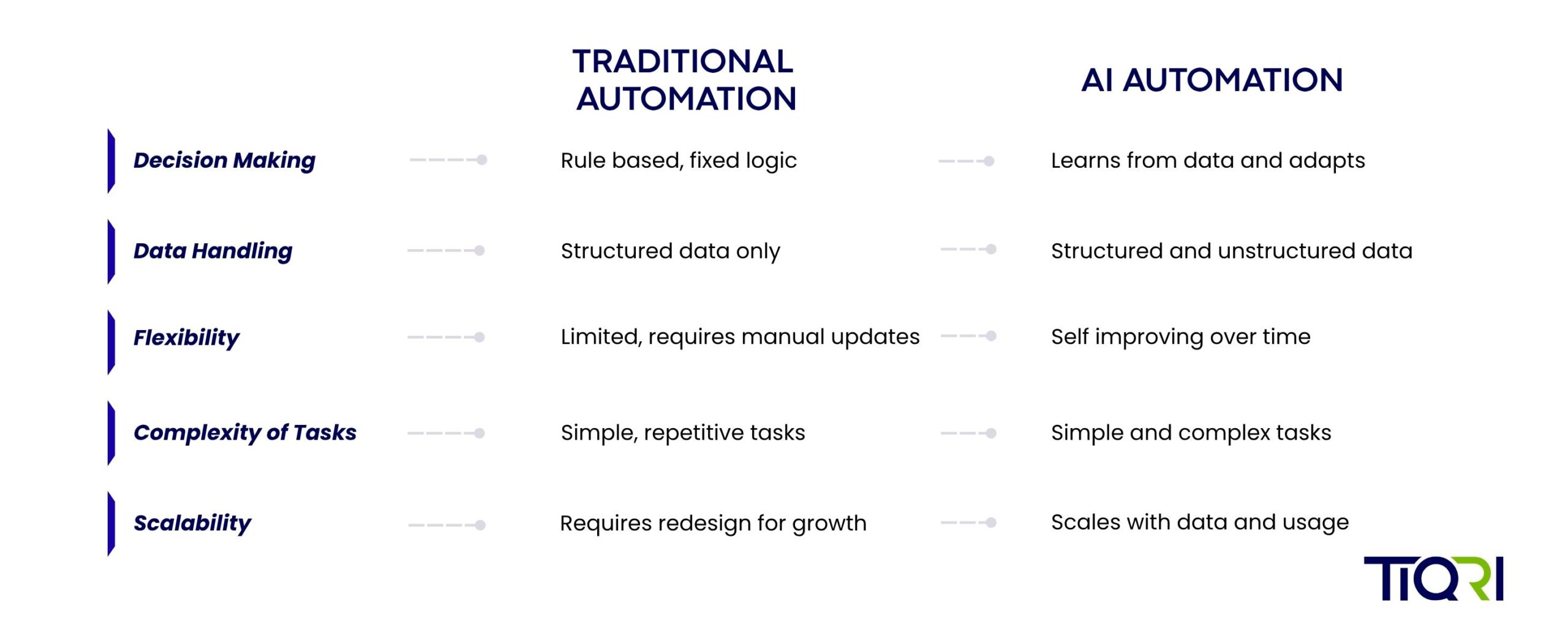
AI Automation vs Traditional Automation

Traditional automation focuses on predefined rules and repetitive tasks. AI automation adds learning and contextual understanding. The comparison in the below table highlights the key differences.


Traditional automation remains valuable for straightforward processes. However, businesses that want systems capable of responding dynamically to change increasingly invest in AI workflow automation to handle end to end processes that involve data interpretation and intelligent routing.

The Importance of AI Automation in Modern Business

Modern industries face rising workloads, increasing customer expectations and rapidly evolving technologies. Customers expect instant responses and seamless, personalised experiences. Meanwhile, internal teams must manage expanding datasets and tighter compliance requirements.

AI automation transforms raw data into actionable insights. By analysing customer interactions, operational metrics and market signals, intelligent systems help businesses understand behaviour patterns and optimise processes. Real-time dashboards powered by AI enable leaders to make informed decisions without waiting for manual reports.

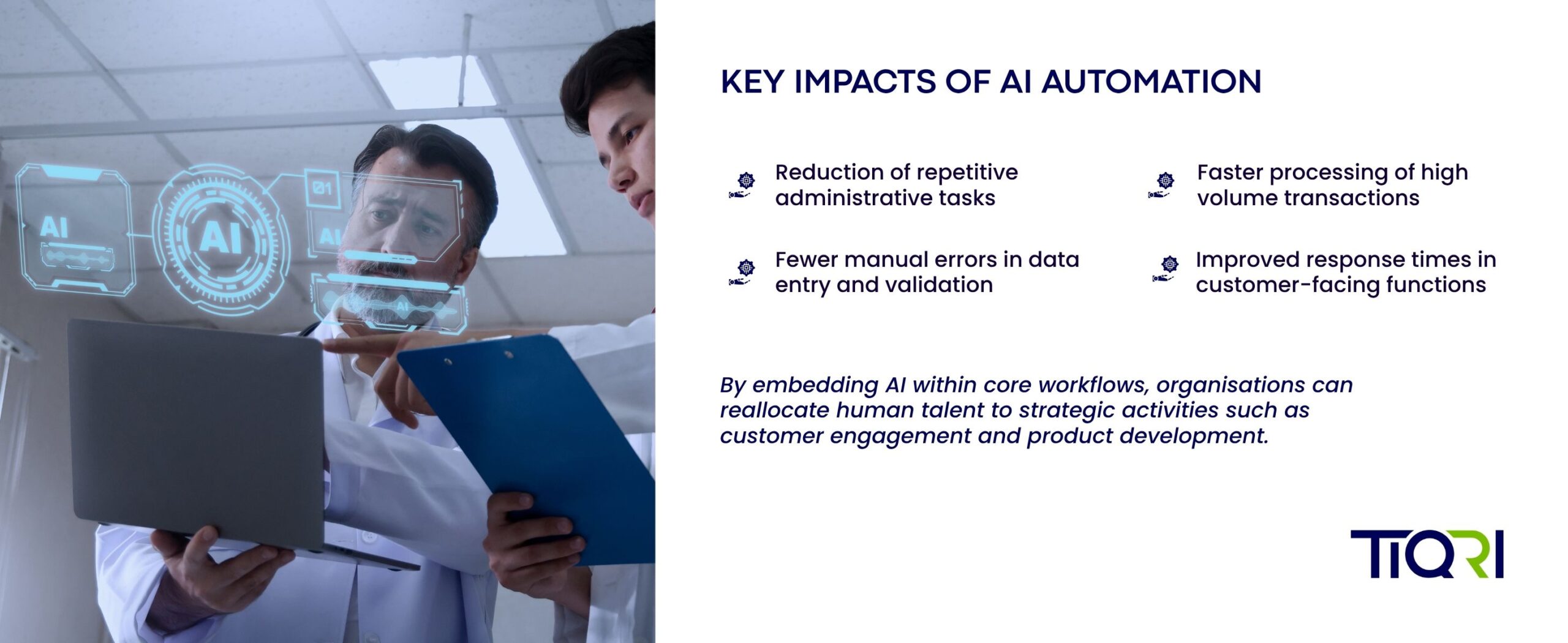
Key impacts include:

  • Reduction of repetitive administrative tasks
  • Faster processing of high volume transactions
  • Fewer manual errors in data entry and validation
  • Improved response times in customer-facing functions


By embedding AI within core workflows, organisations can reallocate human talent to strategic activities such as customer engagement and product development.

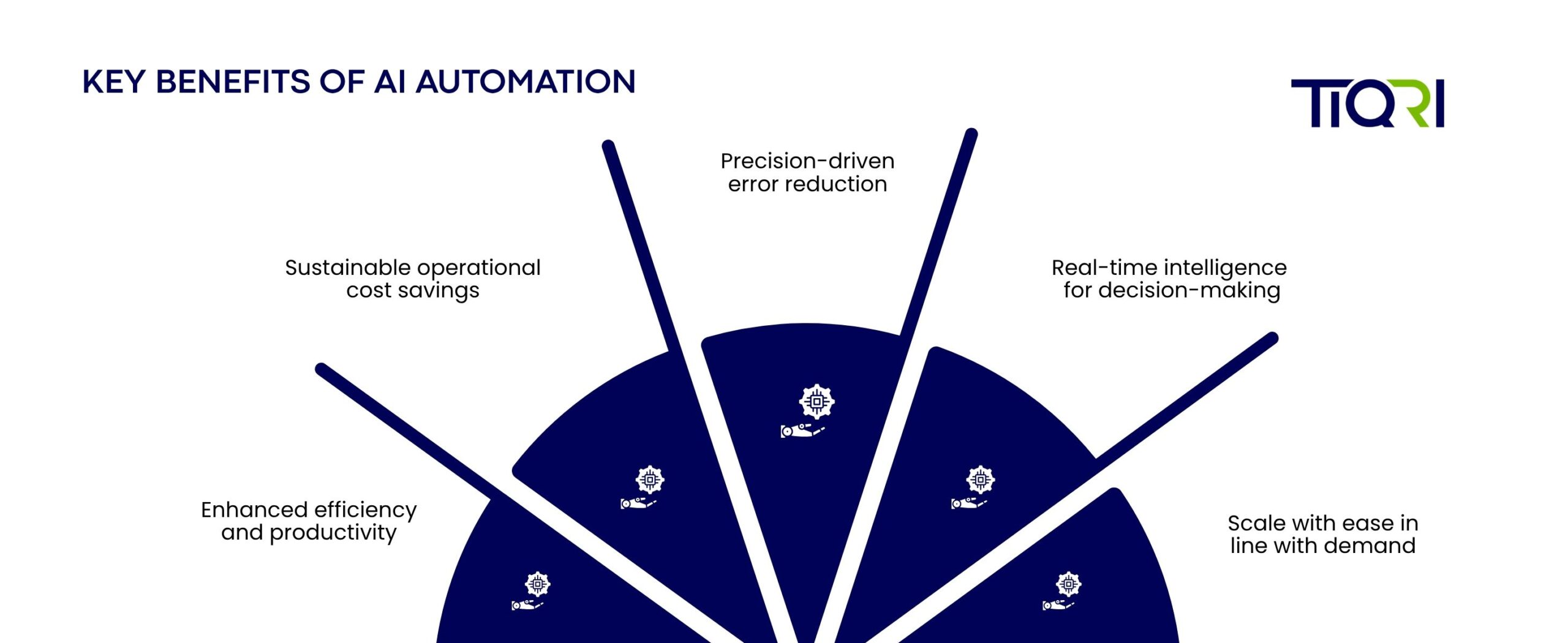
Key Benefits of AI Automation

The benefits of AI automation extend beyond simple time savings. When implemented strategically, AI automation delivers measurable long-term operational and financial advantages.

  • Enhanced Efficiency and Productivity: AI-powered systems operate continuously without fatigue. They handle repetitive and data intensive tasks at a scale that would be impractical for manual teams. 
  • Cost Savings: Automation lowers operational overhead by reducing the need for manual intervention in routine processes. Over time, improved accuracy and faster turnaround also reduce any reworking or penalty costs.
  • Accuracy and Error Reduction: Human errors in data processing, calculations or compliance checks can lead to costly consequences. AI systems apply consistent logic and validation, significantly reducing error rates.
  • Improved Decision-Making: AI tools analyse historical and real time data to identify trends and forecast outcomes. Leaders gain clearer visibility into performance metrics, enabling proactive management.
  • Scalability: As organisations grow, transaction volumes increase. AI-driven systems scale with demand without requiring proportional increases in headcount, making expansion more sustainable.

Industries Benefiting from AI Automation

AI automation has applications across virtually every sector. Its value lies in its adaptability to different operational models.

  • In financial services, AI automates fraud detection, credit scoring and transaction monitoring. 
  • In healthcare, it supports diagnostics, patient data management and appointment scheduling. 
  • Manufacturing leverages AI for predictive maintenance and quality control, reducing downtime. 
  • Retail organisations use intelligent automation to manage inventory forecasting and personalised marketing campaigns.
  • In logistics and supply chain operations, AI-driven systems optimise routing and demand planning. 
  • In customer support environments, AI chatbots and ticket routing tools streamline interactions while escalating complex issues to human agents.


For technology-driven enterprises seeking AI for business transformation, the focus is on integrating AI across platforms, modernising legacy systems and embedding intelligence into digital products. This requires both strategic planning and technical execution.

Driving Sustainable Growth with AI Automation

AI automation is reshaping how organisations operate. By integrating artificial intelligence with automated workflows, businesses gain faster processing, improved accuracy and deeper insights from their data. The shift from rule-based scripts to adaptive systems enables companies to respond to market changes with agility and confidence.


For organisations considering AI as a strategic initiative, the key lies in aligning technology with business objectives. Careful assessment of processes, data readiness and integration requirements ensures sustainable results.


TIQRI supports businesses in this journey by designing and implementing tailored AI solutions that integrate seamlessly with existing systems. Combining technical expertise with practical industry understanding, TIQRI enables organisations to move beyond experimentation and embed AI automation as a driver of measurable business growth. Partnering with an experienced technology provider by getting in touch with the experts at TIQRI today,

Let’s talk about your project

    Reach out for a non-committal chat