Off-the-Shelf vs Custom Software for Enterprises

Software is often purchased to solve a problem quickly, but in large organisations, the wrong choice can quietly create new ones. A platform that seems affordable at the start may later force teams into manual workarounds, duplicate data entry, and reporting delays that waste time across the business.

These inefficiencies are not minor. They affect response times, reduce visibility, and make it harder to scale with confidence. That is why many enterprises eventually start weighing off the shelf software vs custom software more seriously. The real question is not only what works today, but what will continue to support the business efficiently as needs become more specialised and operations become more complex.

What Is Custom Software Development?

Think of a solution built for purpose around the way a business already works, or the way it wants to work in the future. Custom software is developed for a specific organisation, which means the workflows, features, user roles, and integrations are shaped by actual business requirements rather than by a generic product roadmap.

This approach is especially valuable when a company has internal processes that do not fit neatly into standard software logic. Instead of forcing teams to adapt to the tool, the tool is built to support the business. That creates stronger alignment with operational goals and gives enterprises more control over how systems evolve over time.

What Is Off the Shelf Software?

The simplest answer is that it is a ready-made product designed for a broad range of users. These platforms usually come with standard features, faster deployment, and predictable pricing through subscriptions or licence models. 


For businesses with common requirements, that can be enough. Off-the-shelf solutions are often useful in the early stages because they are easier to buy and quicker to implement. 


The challenge appears later, when the business grows or develops needs that fall outside the product’s standard structure. At that point, limitations around flexibility, reporting, and integration can start to slow things down.


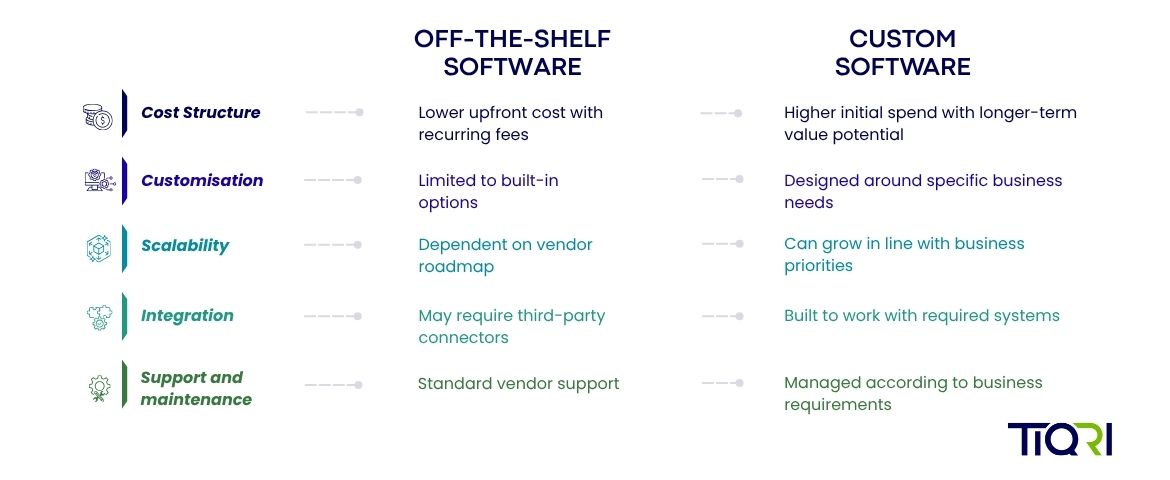
Cost structure

Off-the-shelf software – Lower upfront cost with recurring fees

Custom software – Higher initial spend with longer-term value potential


Customisation

Off-the-shelf software – Limited to built-in options

Custom software – Designed around specific business needs


Scalability

Off-the-shelf software – Dependent on vendor roadmap

Custom software – Can grow in line with business priorities


Integration

Off-the-shelf software – May require third-party connectors

Custom software – Built to work with required systems


Support and maintenance

Off-the-shelf software – Standard vendor support

Custom software – Managed according to business requirements


For enterprises weighing the pros and cons of custom software, the real comparison comes down to control and total cost over time. Off-the-shelf tools are easier to adopt early on, but they often bring licence creep, process compromises, and integration friction as the business expands. Custom software demands more planning upfront, yet it gives organisations the freedom to shape architecture, security, and user experience around actual operating conditions.




How Custom Software Helps Reduce Long-Term Costs

Long-term cost efficiency rarely comes from the cheapest first purchase; it comes from reducing waste. Custom-built platforms can be developed to fit existing teams and processes, which helps enterprises avoid unnecessary spend on workarounds, extra tools, and repeated manual effort.

Some of the clearest benefits of custom software include:

  • Better alignment with real workflows
  • Reducing data duplication
  • More reliable integration with internal and third-party systems
  • Greater flexibility when regulations, services, or business models change


Over time, that can mean fewer delays, better decisions, and stronger returns from technology investment.

Industries Benefiting from Custom Software

The strongest use cases appear in sectors where standard tools struggle to match operational complexity. 

  • In finance, tailored systems can support automation and reduce manual errors in financial workflows. 
  • In healthcare, software often needs tighter control over data handling and reporting. 
  • Manufacturing benefits from software linked to production, inventory, and supply chain visibility. 
  • Retail and eCommerce teams often need integration across storefronts, fulfilment, and customer data. 
  • Logistics businesses rely on efficient tracking and scheduling.
  • Education providers may need platforms designed around specific learner journeys, administration models, or reporting needs.

Building for Long-Term Efficiency

Standard tools can work well for common needs, but businesses with complex processes, integration demands, or long-term scaling goals often gain more from software designed around how they actually operate. 


For organisations looking to improve efficiency and support growth with tailored digital solutions, TIQRI’s Enterprise Software Development services are built around exactly that kind of business-focused transformation. 


Get in touch with our expert team today and explore the right solution for your business.


Let’s talk about your project

    Reach out for a non-committal chat