
Build Better Software by Mastering UX and UI Design

What Is UX and UI Design, and Why Is It Critical to Software Success?

Software success today depends on far more than clean code and advanced features. Users expect products that are intuitive, visually appealing, and easy to navigate from the first interaction. Thus, UI and UX design has become central to product performance. 


Industry data continues to reinforce this; studies show that users form opinions about digital products within seconds, and poor usability is one of the leading reasons for product abandonment. Businesses investing in design-led development consistently report higher retention rates and improved customer loyalty.

 

What is UI and UX?

User Interface (UI) refers to the visual and interactive elements that users engage with. This includes layout, typography, colour schemes, buttons, icons, and overall visual consistency. UI determines how a product looks and how users interact with individual components on screen.


User Experience (UX), on the other hand, focuses on how a product works from the user’s perspective. It covers usability, navigation flow, accessibility, and the ease with which users can achieve their goals. UX is concerned with the full journey, from onboarding to task completion and beyond.


While UI shapes perception, UX shapes experience. Together, they form the foundation of effective digital products.

What is the Difference Between UI and UX?

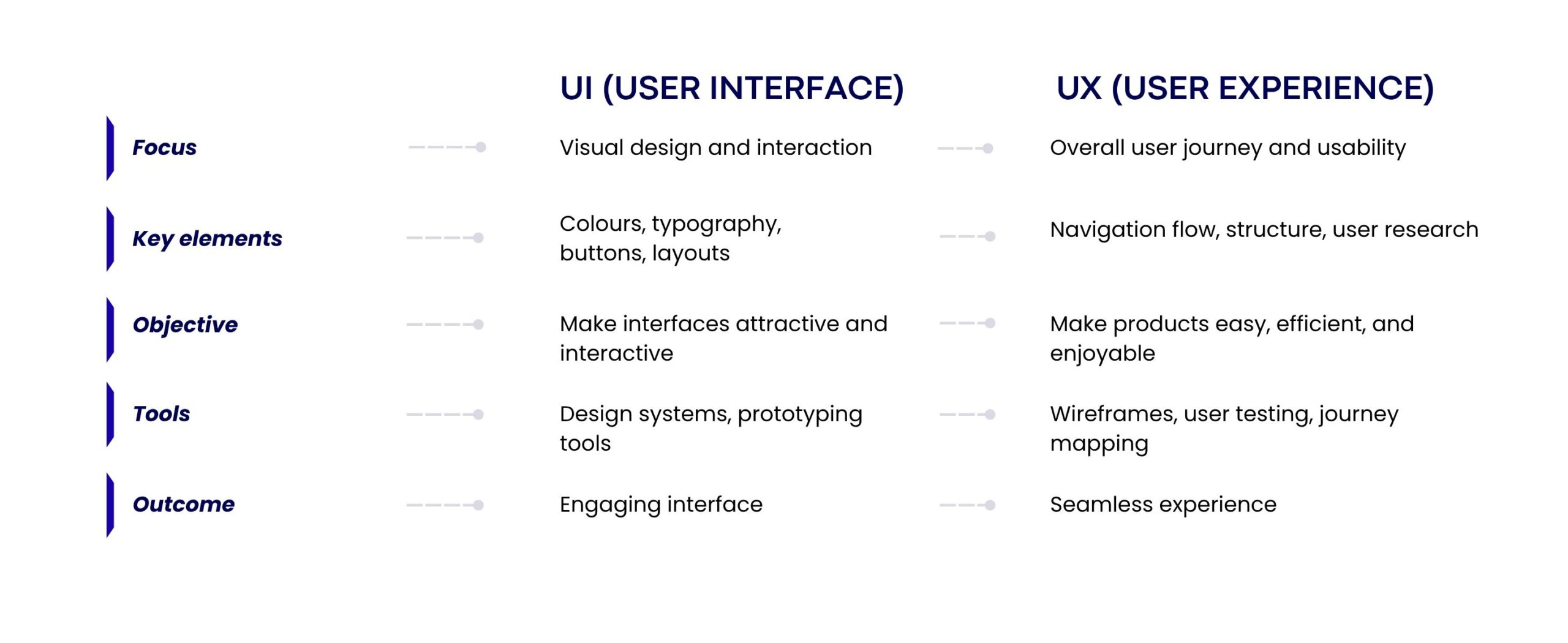
Understanding UI vs UX becomes clearer when viewed side by side:


Focus

UI – Visual design and interaction

UX  – Overall user journey and usability

Key Elements

UI  – Colours, typography, buttons, layouts

UX  –  Navigation flow, structure, user research


Objective

UI – Make interfaces attractive and interactive

UX – Make products easy, efficient, and enjoyable


Tools

UI – Design systems, prototyping tools

UX – Wireframes, user testing, journey mapping

Outcome

UI – Engaging interface

UX – Seamless experience

How UI and UX Work Together

UI and UX are closely connected throughout the product lifecycle. UX design establishes the structure, defines how users move through the system, and ensures logical progression between tasks. It answers questions such as how users complete actions, where information should be placed, and how friction can be reduced.


UI design builds on this foundation by bringing the experience to life visually. It enhances usability through thoughtful design choices, making interactions clear and engaging.


Effective collaboration is essential at every stage:

  • Designers translate user research into actionable insights
  • Developers implement designs while maintaining performance
  • Product stakeholders align design decisions with business goals

When teams work in silos, inconsistencies emerge. When they collaborate, the result is a cohesive product that balances functionality with visual clarity.

Why UI/UX Is Important in Software Development

Understanding why user experience design is important and why user interface design is important requires looking at the tangible impact on business outcomes:

    • Improves customer satisfaction: Well-designed products reduce frustration and help users achieve their goals quickly. This leads to positive experiences and stronger retention.
    • Boosts user engagement: Clear navigation and appealing interfaces encourage users to explore features and spend more time within the product.
    • Enhances efficiency and productivity: In enterprise environments, streamlined workflows reduce time spent on tasks and minimise errors, directly improving operational efficiency.
    • Strengthens branding: Consistent design reinforces brand identity. Users associate well-designed interfaces with credibility and professionalism.
    • Ensures adaptability and scalability: A strong UX foundation makes it easier to introduce new features without disrupting existing workflows. Scalable design systems support long-term product evolution.

Challenges in the UI/UX Design Process

Despite its importance, UI/UX design comes with several challenges that teams must navigate carefully.

  • Balancing user needs with business goals: Design decisions must satisfy both user expectations and organisational objectives, which do not always align perfectly.
  • Maintaining consistency across platforms: Designing for web, mobile, and other platforms requires careful planning to ensure a unified experience.
  • Adapting to evolving user expectations: User preferences change rapidly, requiring continuous research and iteration.
  • Integrating design into development workflows: Tight timelines and technical constraints can limit the ability to fully realise design concepts.
  • Managing stakeholder input: Multiple perspectives can complicate decision-making, especially when priorities differ.

Designing for Long-Term Software Success

UI and UX design play a decisive role in shaping how users perceive, interact with, and ultimately adopt software products. Design influences customer relationships, brand perception, productivity, and long-term competitiveness. Businesses that prioritise user-centred design are better positioned to deliver products that resonate with their audience and adapt to changing needs.


For organisations looking to strengthen their digital offerings, partnering with experienced teams can make a measurable difference. Through its product development and UX design capabilities, TIQRI delivers tailored solutions that align technical excellence with thoughtful design. By combining engineering expertise with a strong focus on usability, businesses can create software that performs reliably and feels intuitive to use.

FAQs

  • What is the difference between a UI and UX developer?
    A UI developer focuses on implementing visual elements and interactive components, while a UX developer or designer focuses on improving usability, navigation, and overall user experience.
  • What is the relationship between UI and UX?
    UI and UX are interconnected. UX defines how a product works and flows, while UI determines how it looks and feels during interaction.
  • Do startups need both UI and UX designers?
    Yes. Even early-stage products benefit from both, as strong design helps attract users, improve retention, and reduce costly redesigns later.
  • What industries benefit most from strong UI/UX design?
    Industries such as fintech, healthcare, e-commerce, and SaaS benefit significantly, where usability, trust, and efficiency directly impact user adoption and business success.


Let’s talk about your project

    Reach out for a non-committal chat